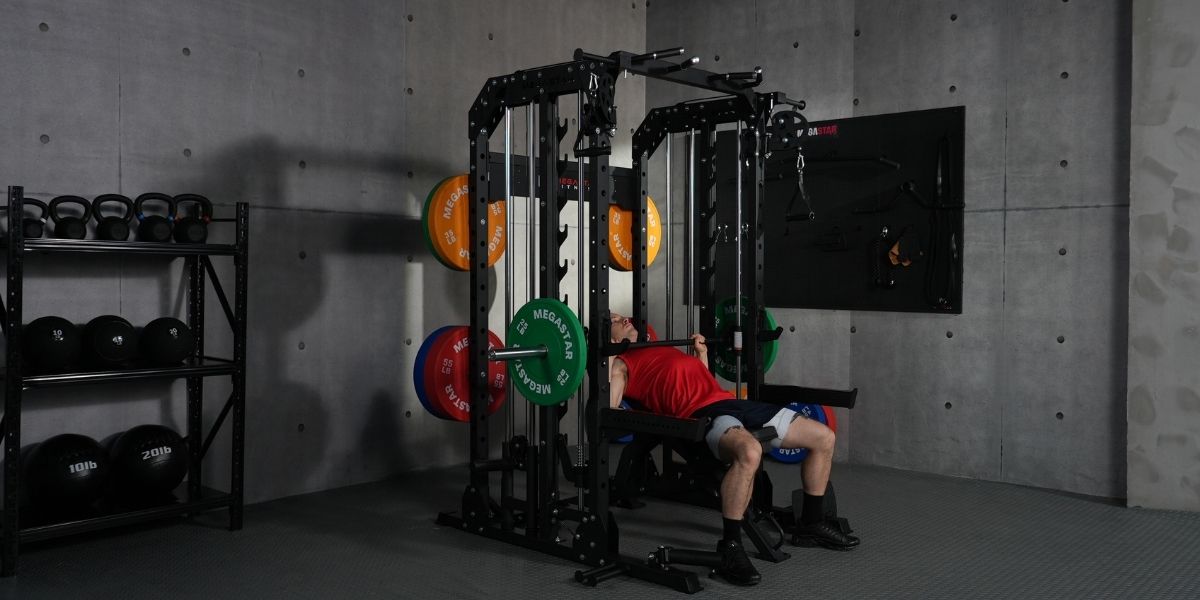
“Two plates a side” sounds simple, until you move to a smith machine. Bar weight, possible counterbalance, and rail angle can make “225” mean something different from what you lift with a free barbell. This guide clears it up with plain-English math, quick tests to find your bar weight, ready-to-use plate charts, and a decision path so you can choose the right load with confidence.
Quick glance: 225 on Smith vs Free Bar
|
Scenario |
What “225” Usually Means |
Typical Plate Setup (per side) |
Notes |
|
Free barbell |
225 lb total |
45 + 45 |
Standard 45-lb bar |
|
Smith, 45-lb bar |
225 lb total |
45 + 45 |
Same as free bar if bar = 45 |
|
Smith, 25-lb bar |
225 lb total |
45 + 45 + 10 |
Because the bar is lighter |
|
Smith, 20-lb bar |
225 lb total |
45 + 45 + 10 + 2.5 |
Requires small plates |
|
Smith, 15-lb bar |
225 lb total |
45 + 45 + 10 + 5 |
Lighter bar = more plates |
Tip: If your smith machine is counterbalanced, the bar’s effective starting weight may be less than the metal bar weighs—use the simple tests below to verify.
What “225” Means On A Smith Machine (Weight Math Basics)
Understand Smith Machine Bar Weight (Include “bar weight” in your log)
-
What varies: Many smith machines use ~15–25 lb bars; some are full 45 lb; some are counterbalanced so the bar “feels” lighter at start.
-
Action steps (Checklist):
-
Find a label on the frame or bar.
-
Ask staff for the bar weight/counterbalance.
-
Test (see “Find Your Bar Weight” below).
-
Write it in your notes/app: “Smith (20 lb bar, counterbalanced).”
-
Find a label on the frame or bar.
- Pro tip: If you train at multiple gyms, keep a note for each smith machine.

Calculate Total Weight For “225” (Simple plate math)
-
Formula: Plates total = Target total – Bar weight
Then: Plates per side = Plates total ÷ 2
- Example: Target 225, bar = 25 → Plates total = 200 → per side = 100 → 45 + 45 + 10.
Adjust For Rail Angle And Friction (Why it can feel easier)
- Angled rails (≈5–12°) change bar path and can alter the feel slightly.
- Guided rails reduce stabilization demands, so some lifters report the same number feels easier than free weights.
- How to use this: Program by RPE (effort) or reps in reserve rather than assuming the number equals your free-bar strength.
Smith Machine Vs Free-Weight: How The Weight Feels
Why 225 May Feel Easier Or Harder
-
Easier: Guided path, less stabilization; smoother reps.
- Harder: Sticky rails, poor footwear/footing, awkward bench alignment, or unfamiliar angled path.
When To Choose The Smith Machine For 225
-
Great for: Solo training, hypertrophy focus, tempo work, partial ranges, injury management, high-rep sets with safeties.
-
Consider free bar: If you’re peaking for powerlifting or need max stabilization carryover.
Common Mistakes That Inflate Your Numbers
-
Half-reps (especially on squats/bench).
-
Bar bouncing off safeties.
-
Not accounting for bar weight or counterbalance.
- Rails not lubed → inconsistent feel set to set.
Find Your Bar Weight (Three Easy Methods)
Label & Ask Method (Fastest)
-
Look for a factory sticker/engraving (bar weight or “counterbalanced”).
-
Ask the front desk or head trainer.
- Record it in your log.
Luggage-Scale Test (Most Accurate, 2 minutes)
-
Hook a luggage scale to the bar’s center knurl with the safeties high.
-
Gently pull to just unweight the bar.
-
The reading ≈ effective starting force (your “bar weight” for math).
-
Note: Do the test at mid-range height for consistency.
Plate-Balance Test (No tools)
-
With empty bar, add small plates evenly until the bar just “floats.”
- Add both sides equally; the total added weight ≈ effective starting force.
Plate Math For 225 On A Smith Machine (Ready-To-Use)
Goal: Total bar + plates = 225 lb
|
Bar Weight |
Plates Total Needed |
Per Side (example stack) |
|
45 lb |
180 lb |
45 + 45 |
|
25 lb |
200 lb |
45 + 45 + 10 |
|
20 lb |
205 lb |
45 + 45 + 10 + 2.5 |
|
15 lb |
210 lb |
45 + 45 + 10 + 5 |
Mini-checklist (Selection steps):
-
Identify bar weight (or effective start force).
-
Subtract from 225.
-
Split evenly per side.
-
Use small plates (2.5/5) to nail the exact number.
- Log the machine + stack for repeatability.
Make It Feel Like Your Free-Bar 225

Use RPE Or A Simple Formula
-
If you measured an effective bar start force S (lbs):
Plates per side ≈ (225 – S) ÷ 2
-
Example: S = 20 → (225 – 20)/2 = 102.5 per side = 45 + 45 + 10 + 2.5.
-
Then fine-tune by RPE: If it feels too easy/hard, adjust 2.5–5 lb per side.
Programming Tips (Keep Progress Comparable)
-
Track machine name, bar S, rail type, foot/bench position.
-
Anchor sets by RPE (e.g., 3×5 @ RPE 7) so the plan adapts across gyms.
- Use top set + back-off structure to auto-regulate.
Safety & Setup For 225 On A Smith Machine
Set Safeties And Bar Path
-
Safeties: One notch below the bottom of your intended range.
-
Squat: Align feet slightly forward under angled rails; brace; keep bar over mid-foot.
-
Bench: Eyes under bar, wrist-elbow stack, bar touches lower chest.
-
Hip thrust: Pad the bar, shins nearly vertical at lockout.
Quick Setup Checklist
-
Bench square to the rails; bar path consistent.
-
Even plates and collars locked.
-
No bounce on safeties.
- Smooth unrack/rerack with hooks fully engaged.
Featured Equipment Highlight: Megastar’s P107 All‑In‑One Smith Machine
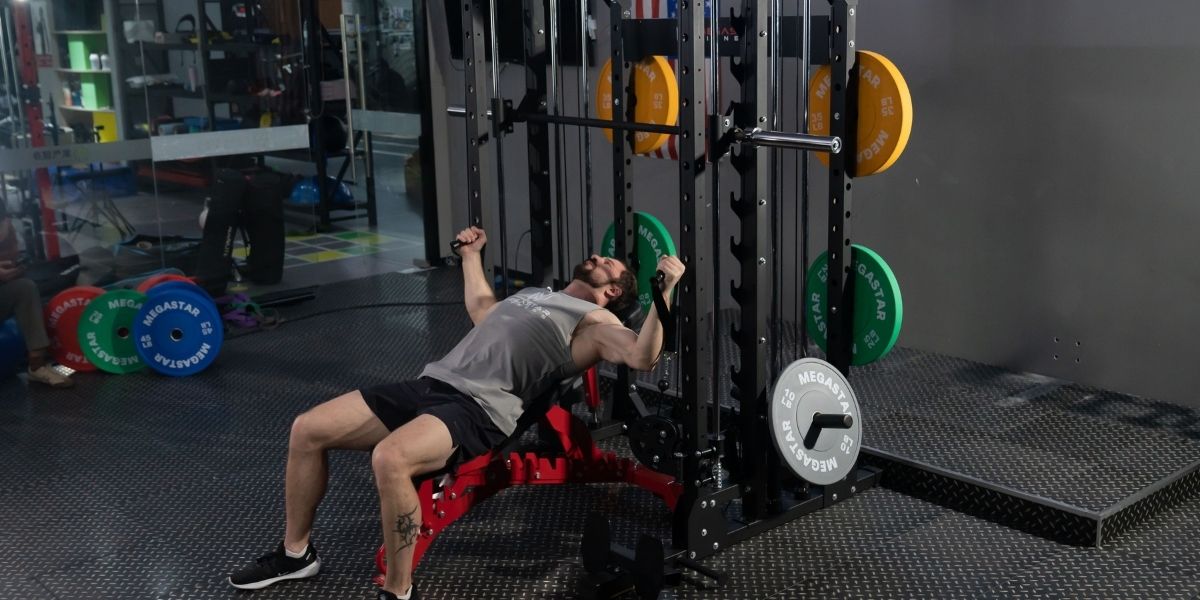
If you're considering investing in a home smith machine, Megastar’s P107 All‑In‑One Smith Machine is a compelling option.
-
It’s a full home gym unit with integrated smith rails, pulleys, and accessories — ideal for users who want to properly test and calibrate “225” scenarios in their own space.
-
It supports heavy loads and offers modular attachments, giving you flexibility as your training evolves.
- Because it combines smith motion and cable systems, you can experiment with real bar weight, counterbalance, and load feel right in your own gym.
Using such a machine makes your bar‑weight tests, plate math, and feel comparisons consistent and repeatable, and no guesswork across different gym machines.
Conclusion: Lift With Confidence On The Smith Machine
Knowing how much 225 truly weighs on a smith machine doesn’t have to be a mystery. Whether you're chasing numbers, switching from free weights, or just trying to set up your training log correctly, it all starts with understanding your machine’s bar weight, calculating the right plate math, and adjusting for feel using RPE.
By using the tests and tools in this guide, you can train smarter, stay consistent across gyms, and hit your goals without second-guessing your setup. Log your machine details, keep your form sharp, and let the Smith work for you—not against you.
FAQs
What is the Smith machine bar weight?
It varies by brand: common are 15–25 lb or 45 lb. Some are counterbalanced, so the effective start force is even lighter. Ask or test, then log it.
Does 225 on a smith machine equal 225 with a free bar?
Math can match, but feel may differ due to rail guidance and friction. Use RPE and track your results per machine.
How do I match my free-weight 225 on the smith machine?
Measure starting force S, then load: per side = (225 – S) ÷ 2. Fine-tune by 2.5–5 lb per side using RPE.
Is a smith machine bad for joints?
Not inherently. Poor setup is the issue. Align feet/bench with the bar path, set safeties, and use a ROM that fits your mobility.
Why does my smith machine feel sticky?
Dirty/dry rails or worn bushings. Ask staff to clean/lube the guides; it can change perceived load and rep quality.
What plate combo gives me 225 if my bar is 20 lb?
You need 205 lb plates total → 102.5 per side: 45 + 45 + 10 + 2.5.
Should beginners use the smith machine for 225?
Yes, if technique and safety are dialed in. Start lighter, use RPE 6–7, and progress in small jumps.